

How Dual-Sided Heating Improves Thermal Balance
Traditional heated gloves mainly place heating elements on the back of the hand. While this provides a direct heat source, it can leave areas such as the palm and fingers without direct heating coverage.
Dual-sided heating addresses this limitation by distributing heat across both the back and palm of the hand, while full-hand heating designs can extend coverage toward the fingers and fingertips. This approach provides broader thermal coverage rather than concentrating the primary heat source on a single surface.
The design is particularly useful in cold environments where different parts of the hand experience different levels of exposure, movement, pressure, and contact-related heat loss.
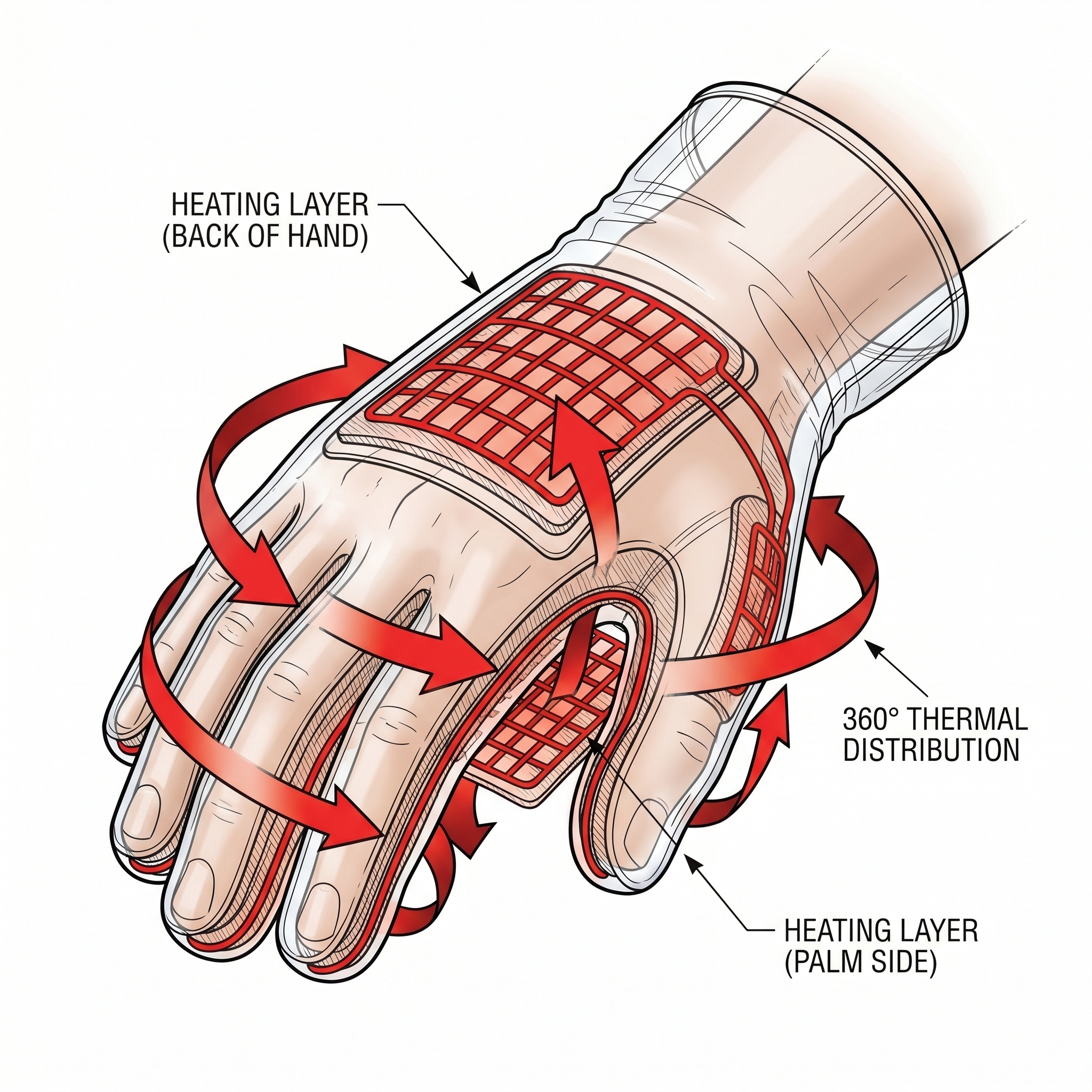
Dual-sided heating structure for balanced warmth across the palm and back of the hand.
J ONE’s dual-sided heating technology has been fully integrated into Ololar, a dedicated warming brand focused on people with Raynaud’s and cold-sensitive hands. Ololar applies this heating architecture to its heated glove designs for different everyday and outdoor warming needs.
Why Traditional Heated Gloves Are Uneven
The back of the hand is typically used for heating integration because it provides a relatively accessible area for placing heating elements. However, the palm and fingers have different operating conditions.
During everyday use, the palm and fingers are continuously exposed to:
- Gripping and holding objects
- Repeated hand movement
- Pressure against surfaces
- Friction and physical contact
- Direct contact with cold equipment or handles
These factors can increase local heat loss even when the back of the hand remains warm.
As a result, heating only the back of the hand does not necessarily provide balanced thermal coverage across the entire hand.
How Dual-Sided Heating Works
A dual-sided heating system places heating elements across both major surfaces of the hand rather than concentrating the primary heat source on the back alone.
- Back heating layer: Provides direct heat to the exposed back of the hand.
- Palm heating layer: Supports warmth in an area subject to gripping, pressure, and frequent contact.
- Finger coverage: In full-hand heating designs, heating coverage can extend toward the fingers and fingertips.
- Balanced distribution: Distributes available heat across the intended hand areas rather than relying on a single heating surface.
The objective is not simply to increase total heat output. It is to distribute available heat more effectively according to how the hand interacts with the surrounding environment.
Thermal Balance During Real Use
Hand temperature can change continuously during use.
For example, the back of the hand may be directly exposed to cold air while the palm is repeatedly contacting a handle or another cold surface. The fingers also remain exposed to cold air and move continuously during gripping and other activities.
A dual-sided heating architecture allows the heating system to address different sources of heat loss across the hand simultaneously. When the heating design extends into the fingers, it can provide additional coverage in areas that are particularly exposed during cold-weather use.
This can provide more balanced thermal coverage across the back, palm, and, where designed for it, the fingers and fingertips.
Engineering Considerations
Adding heating elements to both sides of the hand introduces additional engineering requirements, particularly when heating coverage extends toward the fingers.
The heating system must account for:
- Element placement: Heating elements need to be positioned without unnecessarily restricting natural hand movement.
- Flexibility: Palm and finger areas require repeated bending and movement during use.
- Thermal distribution: Heat needs to spread across the intended areas without creating unnecessary localized hot spots.
- Power management: Additional heating areas require appropriate power allocation and system control.
- Glove integration: Heating components must work with the glove’s materials, construction, and intended use conditions.
For this reason, dual-sided heating is a system-level design approach rather than simply adding a second heating element.
Dual-Sided vs. Back-Only Heating
| Heating Architecture | Typical Coverage | Main Consideration |
|---|---|---|
| Back-only heating | Back of hand | Heat is concentrated on one surface |
| Dual-sided heating | Palm + back of hand | More balanced thermal coverage |
| Full-hand heating design | Palm + back of hand + fingers | Broader coverage across the hand |
The appropriate architecture depends on the intended use, operating environment, glove construction, and required balance between warmth, flexibility, and power consumption.
Application Scenarios
Dual-sided heating can be particularly useful in situations where the hands experience both environmental exposure and frequent physical contact.
- Skiing: Both sides of the hand can be exposed to low temperatures during extended outdoor activity.
- Photography: Users may need warmth while maintaining precise control of equipment.
- Riding: The palm remains in continuous contact with handlebars while the back of the hand and fingers are exposed to cold air.
- Outdoor operation: Workers may repeatedly grip tools or equipment in cold environments.
- Long-duration static exposure: Broader thermal coverage can be useful when hands remain exposed to cold for extended periods.
J ONE Technology Applied to Ololar
J ONE developed its dual-sided heating approach as part of a broader wearable heating system architecture. The technology involves more than the placement of heating elements; it includes heating element integration, thermal distribution, power management, temperature control, and product-level implementation.
Within Ololar’s heated glove designs, J ONE’s dual-sided heating architecture is applied to the palm and back of the hand. The technology is adapted within Ololar’s glove designs according to their intended use and product construction.
Ololar’s full-hand heating approach can extend thermal coverage toward the fingers and fingertips, depending on the specific glove design.
This allows the underlying J ONE heating architecture to be adapted across different Ololar glove designs and intended-use scenarios, from indoor everyday activities to outdoor environments.
Core System
The dual-sided heating system can be understood as a connected system rather than an isolated heating element:
Heating Materials → Power System → Thermal Distribution → Temperature Control → Glove Integration
Each component affects the final heating performance. Heating materials determine how electrical energy is converted into heat, the power system supplies the required energy, thermal distribution determines where that heat is delivered, temperature control manages the available heating levels, and glove integration determines how the system performs during actual hand movement and use.
Related Pages
- Why Most Heated Gloves Only Heat the Back of the Hand
- Precision Hand Control Requirements
- Cold Hand Performance Impact
- Buying Guide
- JHG43 Dual-Sided Heated Gloves
FAQ
What is dual-sided heating in heated gloves?
Dual-sided heating places heating elements on both the back and palm of the hand to provide more balanced thermal coverage. In full-hand heating designs, coverage can also extend toward the fingers and fingertips.
Why is dual-sided heating different from back-only heating?
Back-only heating concentrates the primary heat source on one surface of the hand. Dual-sided heating adds a heating layer to the palm, helping address heat loss associated with gripping, pressure, and contact.
Does palm heating improve warmth?
Palm heating can provide additional warmth in an area that experiences frequent gripping, movement, pressure, and contact with surrounding objects. Its effectiveness depends on the overall heating architecture and product design.
Does dual-sided heating use more battery?
Additional heating areas can increase power requirements. Overall energy consumption depends on the heating elements, power system, temperature settings, control strategy, and operating conditions.
Does dual-sided heating heat the fingers?
Dual-sided heating describes heating elements positioned across the palm and back of the hand. In full-hand heating designs, the heating coverage can also extend to the fingers and fingertips.
Medical Note: Heated gloves are designed to provide external warmth and comfort. They are not intended to diagnose, treat, cure, or prevent Raynaud’s disease or any other medical condition. People with persistent, severe, or worsening symptoms should consult a qualified healthcare professional.