

How Heating Element Placement Shapes Flexibility and Coverage
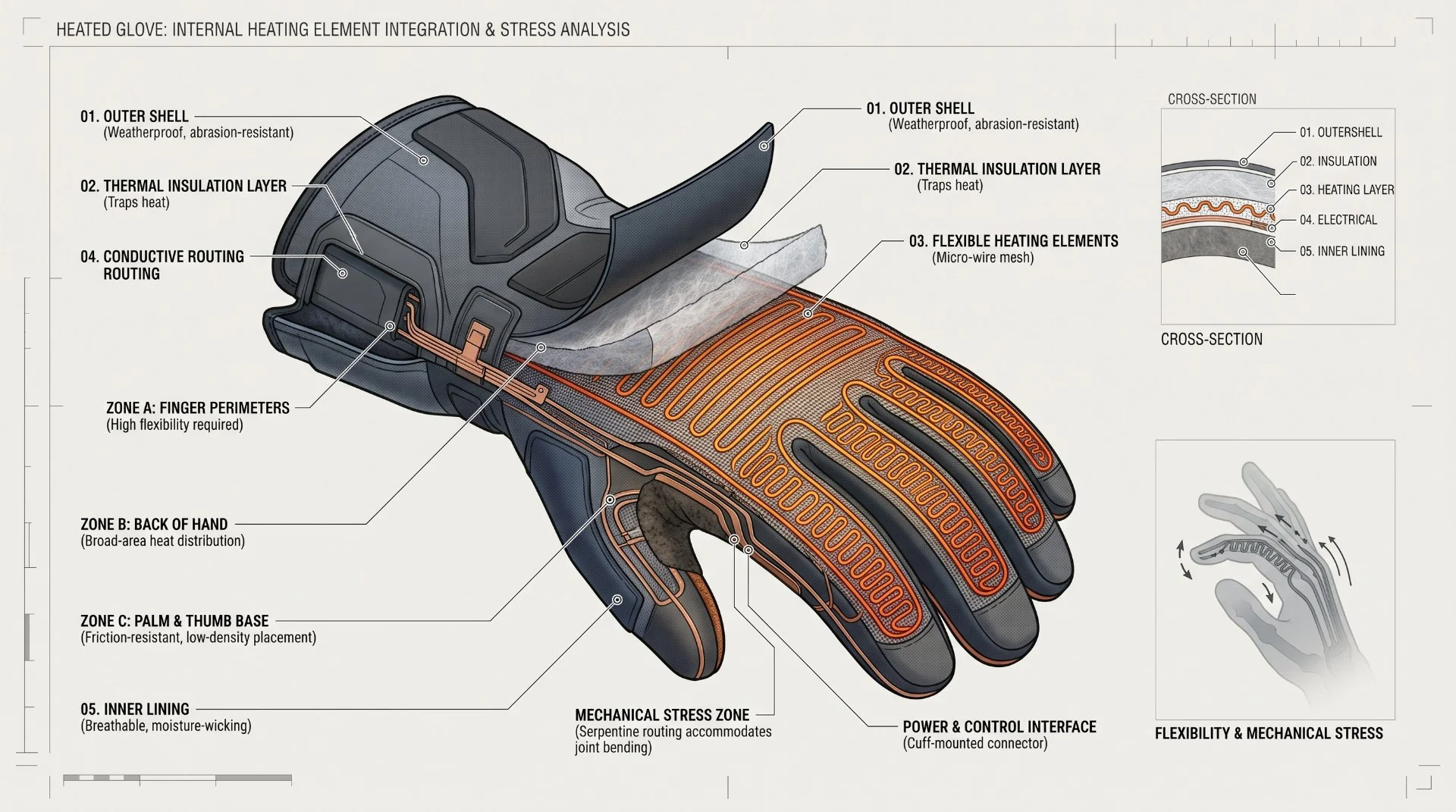
Heating element placement in a heated glove — where the heated glove heating element meets movement, routing, and construction — is not simply a question of where warmth is needed. The location of an element changes how the glove bends, how electrical connections are routed, how the textile is constructed, and how the heating system survives repeated mechanical loading and washing.
Research on wearable electrical heating textiles similarly treats the heating element as part of an integrated system rather than an isolated component. Flexible substrates, conductive paths, heating components, and power systems have to work together within the constraints of the wearable structure.
Placement Changes More Than Thermal Coverage
A heating element can provide useful thermal coverage and still create a poor wearable system if its location conflicts with movement or construction.
For a heated glove, placement has to be considered together with:
- thermal coverage
- hand and finger movement
- element flexibility
- electrical routing
- textile layering
- mechanical fixation
- power distribution
- repeated bending
- washing and maintenance
- manufacturing constraints
This is why the warmest-looking area on a drawing is not automatically the best location for a heating element.
The Heating Element Itself Changes the Design
Different heating structures create different placement constraints. Wire-based elements, printed or resistive textile structures, and thin-film elements do not behave identically when integrated into a glove.
The difference is not only electrical resistance or heating output. Element geometry also determines how much area can be covered, how tightly the element can follow a textile surface, and how the structure behaves when the glove bends.
A long narrow element may work well in one zone but become difficult to route through another. A broader resistive area may improve coverage but require more space within the textile stack. A thin-film structure may provide a different balance between coverage, flexibility, and integration.
For this reason, element type and placement should be designed together rather than selected independently.
These are part of the broader engineering considerations covered within J ONE’s product technology framework.
Where the Element Sits in the Textile Stack Matters
Placement is also a vertical decision, not only a horizontal one.
An element can be positioned between the outer shell and insulation, within an intermediate textile layer, or closer to the inner lining. These positions affect how heat moves through the glove and how the surface temperature behaves during operation.
Moving an element closer to the hand does not simply mean “more heat.” It changes the thermal path between the heating source, surrounding materials, and the wearer-facing surface.
The opposite arrangement can provide a different thermal distribution while creating additional requirements for insulation, heat spreading, and structural integration.
That is why heating placement has to be evaluated as part of the complete textile layer structure rather than as an isolated position on a pattern.
Flexing Zones Are Not Off-Limits — They Have Higher Requirements
Finger areas are a good example of why heating coverage cannot be separated from mechanical design.
Fingers repeatedly flex and extend during normal use. If a heating element crosses a high-movement area, the element and its surrounding construction may experience repeated deformation over the product’s service life.
Research on textile electronic systems also highlights the importance of mechanical flexibility, reliable electrical connectivity, system integration, durability, and manufacturing when electronic structures are incorporated into textiles.
This does not mean that heating elements should never cross a flexing zone. It means that the element geometry, routing, fixation, and surrounding textile construction have to accommodate that movement.
Placing more element in a flexing finger is not a free gain — it changes how the textile bends, how it fails, and how it survives washing. Placement is where coverage, durability and comfort intersect, which is why element geometry has to differ between zones.
This is the central engineering problem behind heating element placement: increasing coverage can change the mechanical behavior of the wearable at the same time.
Why Finger Heating Cannot Simply Copy Palm Heating
The palm and fingers provide different engineering environments.
A palm heating element can often use a broader geometry because the available surface is relatively continuous. Fingers provide narrower paths and repeated bending points, which can require different element lengths, spacing, routing, and fixation.
For example, a heating structure designed for a broad palm area cannot necessarily be reduced proportionally and placed along a finger. The reduced space changes the geometry, bending behavior, and electrical routing requirements.
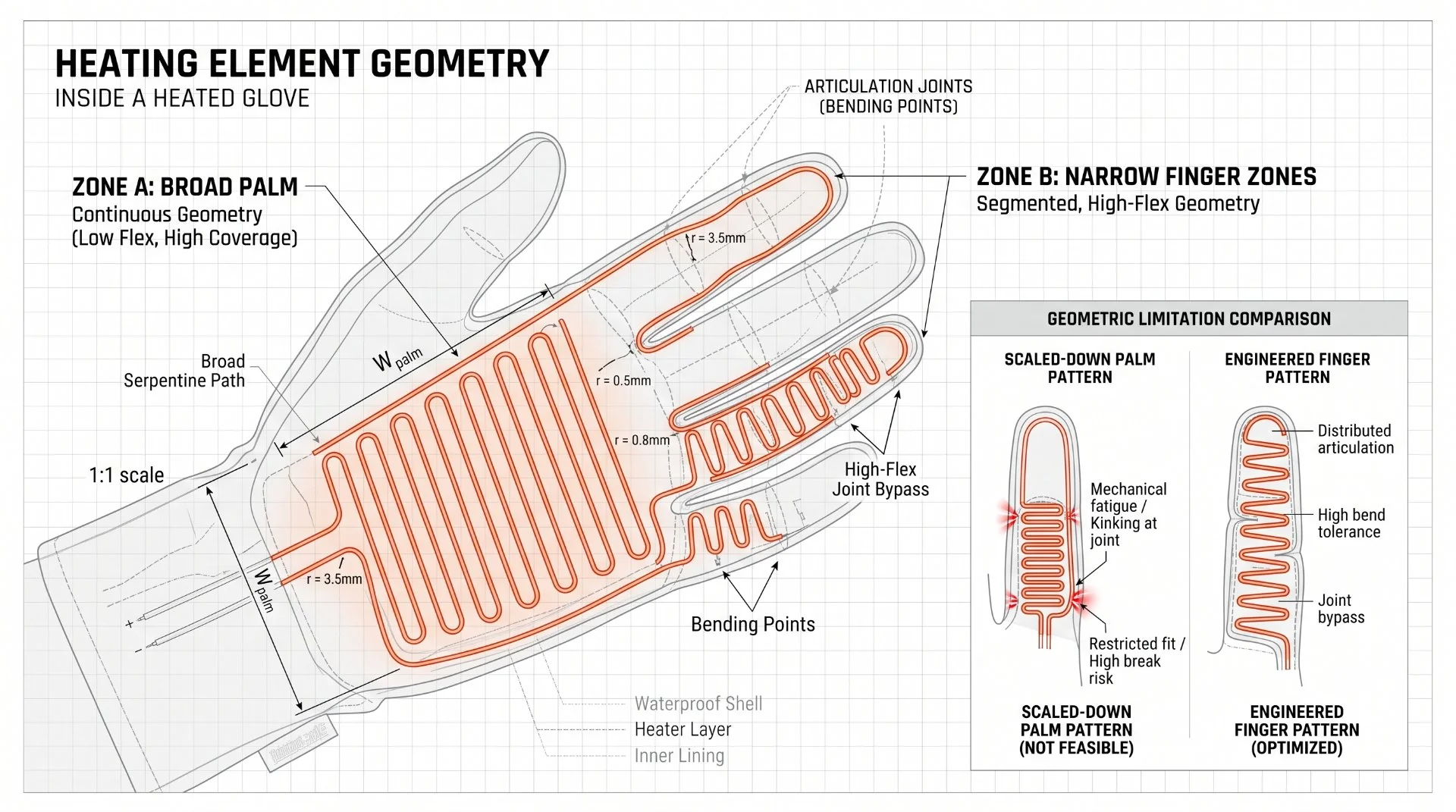
This is also why palm and back-of-hand heating layouts should be evaluated according to their respective coverage and movement requirements rather than treated as interchangeable placement options.
This is one reason a heated glove may use different element geometries in different zones rather than treating the entire glove as one uniform heating surface.
Coverage Density and Element Geometry Have to Be Balanced
More heating area does not automatically produce a better design.
Increasing coverage density can improve the distribution of active heating, but it can also reduce the available space for flexing, routing, seams, insulation, and structural reinforcement.
The relationship is therefore not:
More element = better heating.
A more useful engineering relationship is:
Required coverage + appropriate geometry + compatible construction = usable heating system.
The correct balance depends on the zone being heated and the mechanical demands placed on that zone.
Connections Can Be More Critical Than the Heating Area
A heating element is only one part of the electrical path.
Each heating zone also requires conductive routing and connections back to the power and control system. Those connections can experience the same movement constraints as the heating element itself.
This becomes particularly important in fingers, where the available routing space is limited and repeated bending is unavoidable.
A design can therefore have an adequate heating surface while still having a weak point at a connection, transition, or routing section.
For wearable heating systems, the electrical path has to be evaluated together with the mechanical path.
Placement Must Survive the Glove Construction Process
A heating element does not exist independently of the glove that contains it. Sewing, bonding, lamination, cutting, folding, and layer assembly can all influence the final position and mechanical behavior of the heating structure.
The heating system therefore has to be compatible with the construction sequence from the beginning.
For example, an element that looks correctly positioned on a pattern may shift during assembly if its fixation method is insufficient. A connection that works at the component level may become vulnerable after the surrounding textile is repeatedly flexed.
This is why heating-system architecture has to be considered together with the physical construction of the wearable product.
J ONE approaches heated wearable development from this system perspective: heating placement is part of the overall heating architecture, not a component added after the glove structure has already been decided.
Washing Is Part of the Placement Problem
For washable heated wearables, the design also has to account for repeated mechanical and electrical stress during washing and drying.
Washing can introduce bending, compression, twisting, moisture exposure, and repeated movement throughout the textile assembly. The relevant question is therefore not only whether the heating element works when new, but whether its position, connections, and fixation remain suitable after repeated use and maintenance cycles.
Washability should consequently be treated as a design input rather than a final test added after the heating layout has already been fixed.
Placement and Thin-Layer Construction Are Closely Connected
The less space available inside a heated wearable, the more precisely the heating element has to be integrated.
Thin-layer systems leave less room for insulation, routing, structural reinforcement, and separation between components. This makes the relationship between element position, coverage density, flexibility, and construction more tightly coupled.
For a deeper look at why reducing the thickness of a heated wearable changes the engineering problem rather than simply removing material, see why thin-layer heated systems are harder than thick ones.
Placement Also Has to Match the Required Thermal Coverage
Element placement should begin with the required thermal coverage rather than with a fixed assumption that one location is always superior.
The required coverage may depend on the application, the exposed areas of the wearable, the available insulation, and how the wearer uses the product.
That is why there is no universally optimal heating layout for every heated glove application.
Coverage should be defined first, and then the element geometry, location, routing, and construction should be developed around that requirement.
This is closely related to the engineering question of how heating coverage and insulation work together to determine hand warmth.
There Is No Single “Best” Heating Element Location
A common design mistake is to search for one universally correct location for a heating element.
In practice, the correct location depends on the required coverage, the movement pattern of the zone, the element type, the textile stack, electrical routing, power requirements, fixation method, and expected mechanical and washing conditions.
Back-of-hand placement may be practical for one design. Palm placement may be appropriate for another. Finger-level heating may be necessary when coverage requirements extend into the digits, but it also introduces tighter mechanical and routing constraints.
The engineering problem is therefore not simply choosing a warm area. It is finding a placement and geometry that satisfy the complete set of system constraints.
A Practical Placement Review for Heated Wearable Development
Before finalizing a heating layout, an engineering team should evaluate at least these questions:
- What thermal area actually needs active heating?
- What heating-element form is appropriate for each zone?
- Where will the element sit within the textile layer structure?
- Which areas experience repeated bending?
- Does the element cross a major flexing point?
- How will electrical connections be routed?
- Where are the highest mechanical loads?
- How will the element remain in its intended position?
- How will the layout behave during washing and maintenance?
- Does the available power support the required heating coverage?
- Can the proposed layout be manufactured consistently?
These questions turn heating placement from a pattern-making decision into a system-design decision.
J ONE Engineering Perspective
J ONE understands that heating-element placement is a joint design problem across coverage, flexibility, and washability — not a location chosen on a diagram.
For cold-sensitive wearables, this becomes particularly important because the required thermal coverage has to coexist with natural movement, textile construction, electrical routing, and long-term durability. Placement is therefore a control-design property as much as a physical layout decision.
The key principle is simple: placing more heating element in a moving zone is not a free gain. Every increase in coverage changes the geometry, mechanical behavior, routing, construction, and durability requirements of the heating system.
FAQ
What is the best heating element placement for a heated glove?
There is no single best location for every heated glove. The appropriate placement depends on required thermal coverage, movement, element geometry, textile construction, electrical routing, power requirements, and durability requirements.
Why does heating element placement affect glove flexibility?
Heating elements and their electrical connections occupy physical space within the textile structure. When they cross areas that repeatedly bend, their geometry, fixation, and routing have to accommodate that movement without creating excessive mechanical stress.
Why are finger heating elements different from palm heating elements?
Finger zones are narrower and experience more repeated flexion and extension than broad palm areas. As a result, finger heating may require different element lengths, geometry, density, routing, and fixation.
Does adding more heating coverage always make a heated glove better?
No. More coverage can increase the heated area, but it can also reduce available space for movement, insulation, routing, seams, and structural reinforcement. The useful target is appropriate coverage rather than maximum coverage.
Why does washing matter when deciding heating element placement?
Washing can expose the heating system and its connections to repeated bending, compression, twisting, and moisture. Placement and fixation therefore need to be designed with expected maintenance cycles in mind rather than tested only after the layout is finalized.