

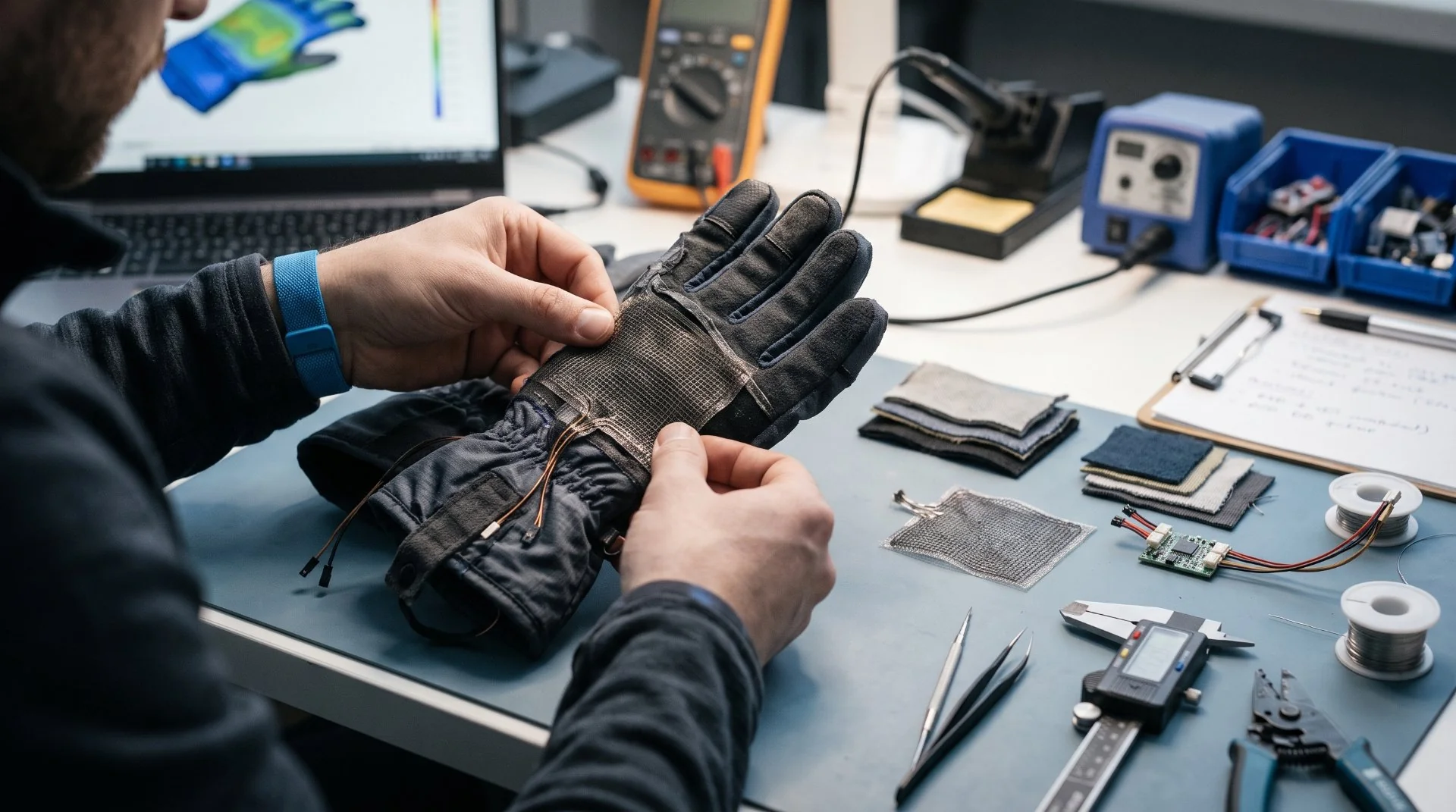
A heated wearable is not created by adding a heating element to an existing garment. A heated gloves OEM manufacturer must translate the intended application into measurable thermal requirements, develop a heating system that can meet them, integrate that system into the garment, and verify the result under relevant operating conditions.
A thermal requirement is not a specification handed down — it is something a manufacturer has to understand first. The path runs from understanding the application, to defining the thermal requirement, to developing the heating system, to engineering the wearable. Each step loses precision if the previous one was guessed.
The difficult work lies in the transitions between these stages. A requirement that is unclear at the beginning can become a poorly specified heating system, an unsuitable garment construction, or a prototype that looks correct but does not deliver the intended performance.
1. Understand the Application Before Defining the Heat
The first step is to understand how and where the wearable will be used. The same glove may face very different engineering demands depending on the environment, exposure duration, hand movements, contact with objects, and the wearer’s need for dexterity.
An application statement should establish the conditions that matter to the design, including:
- Operating environment: the expected ambient conditions and exposure to wind, moisture, or changing temperatures.
- Use duration: how long the wearable is expected to operate during a typical use period.
- Contact and movement: whether the hand grips tools, handles objects, operates controls, or performs fine movements.
- Required coverage: which parts of the hand need active heating and which areas are supported by insulation or other layers.
- Wearable format: whether the heating system is integrated into a standalone glove or a thin liner worn under another glove.
Output of this stage: an application statement. It gives the engineering team a defined use context against which thermal and construction decisions can be evaluated.
The first engineering judgment is often the most consequential: without a clear application statement, a thermal specification may describe a technically measurable target that is unsuitable for the actual use case.
2. Convert the Application into a Thermal Requirement
An application statement describes the use context. A thermal requirement translates that context into what the heating system must deliver and what constraints it must respect.
For heated gloves and other hand-warming wearables, the requirement may define:
- Coverage extent and zones: the areas that require active heating, such as the palm, back of the hand, or fingers.
- Target temperature range: the intended operating range, with surface-temperature limits considered separately.
- Sustained output: the heat the system must continue delivering over the required operating period, rather than only its peak output.
- Runtime: the required operating duration under a stated power level or test condition.
- Surface and comfort limits: temperature constraints and construction conditions that affect how heat can be delivered.
- Physical constraints: the available thickness, flexibility, weight, and space for the heating system and electrical components.
These requirements must be considered together. Increasing heating coverage may affect power demand. Reducing garment thickness may limit element placement. Extending runtime may require changes to the power system or operating strategy.
Output of this stage: a thermal specification. It defines the performance target and the boundaries within which the heating system must be engineered.
3. Develop the Heating System
Once the thermal requirement is defined, the manufacturer can develop a heating-system design. This stage connects the intended heat delivery to the physical and electrical architecture that can produce it.
The principal decisions include:
- Heating-element form: selecting an element structure compatible with the required heat delivery, garment thickness, and flexibility.
- Element placement: positioning the heating elements to provide the intended coverage without unnecessarily restricting movement.
- Coverage continuity: evaluating gaps between heated areas and the effect of seams, folds, and construction boundaries.
- Power level: determining the electrical demand associated with the required output and operating conditions.
- Control strategy: defining how the system adjusts or maintains output across its operating settings.
- Power-system integration: coordinating the battery or external power source with the heating elements and controls.
Heating-element selection alone does not define system performance. Element geometry, placement, available power, control behavior, and the surrounding textile structure all affect the result.
For example, a design may use a suitable heating element but still fail to deliver the intended coverage if the element is placed incorrectly or leaves important areas unheated. A system may also reach a high output briefly without sustaining the required heat for the intended operating period.
Output of this stage: a defined heating-system design. The design connects the thermal specification to element layout, power requirements, and control behavior.
4. Engineer the Heating System into a Wearable Product
A heating-system design is not yet a manufacturable garment. The next stage integrates the electrical and thermal architecture into a product that can be assembled, worn, moved in, and evaluated.
Product engineering must address several connected constraints:
- Textile layers: coordinating the outer material, lining, insulation, and heating elements without creating unsuitable bulk or restricting heat delivery.
- Construction and seams: determining how components fit within the garment and how seams or transitions affect coverage and durability.
- Wiring and component routing: positioning electrical connections and controls while accounting for movement, abrasion, and repeated bending.
- Flexibility: checking how the integrated system behaves at the joints and areas that move most frequently.
- Moisture exposure: defining the expected exposure and evaluating its implications for materials, electrical protection, and maintenance.
- Manufacturing consistency: establishing a construction that can be reproduced reliably rather than working only in an individual prototype.
- Applicable compliance requirements: identifying the relevant electrical, battery, material, and product requirements for the intended markets and product configuration.
The garment format also changes the design constraints. A heated liner worn under another glove shares some of its thermal environment with the outer glove. A standalone heated glove must be engineered as a more complete wearable system, including its own outer construction and insulation. These formats should not be treated as interchangeable versions of the same design.
Output of this stage: a buildable product definition. It describes how the heating system, electrical components, textiles, and construction work together in a product intended for repeatable production.
5. Validate the Product Against the Thermal Specification
A prototype is evidence of progress, not proof that the product meets its requirements. Validation must compare actual performance with the defined thermal specification and the conditions the wearable is expected to encounter.
Depending on the application and product design, validation may examine:
- Heating coverage and temperature distribution across the intended zones.
- Sustained output over the required operating period.
- Runtime under a documented operating setting and test condition.
- Surface temperatures and control behavior across the intended settings.
- Performance during bending, gripping, and other relevant movements.
- Durability of heating elements, wiring, connections, and textile construction.
- Relevant moisture-resistance, electrical-safety, and compliance requirements.
Testing conditions matter. A stationary test may demonstrate that a heating element produces heat, but it cannot by itself establish how the complete garment will perform during movement, contact, wind exposure, or changing ambient conditions. The validation plan must reflect the application and the claims the product is expected to support.
Output of this stage: documented evidence. Test results show which requirements have been met, which remain unresolved, and whether the product definition needs further engineering work.
Why the Handoffs Determine the Result
The manufacturing process is a connected chain rather than a collection of independent tasks. Each stage uses the output of the previous stage as its input. If that input is incomplete or based on an assumption, later engineering work can become precise in execution while remaining wrong for the application.
| Stage | Required input | Output | Risk if the input is unclear |
|---|---|---|---|
| Application understanding | Use environment, duration, movement, and contact | Application statement | The design solves the wrong use case |
| Thermal definition | Application statement | Thermal specification | Coverage, output, or runtime targets remain ambiguous |
| Heating-system development | Thermal specification | Heating-system design | Element layout, power, or control does not match the requirement |
| Product engineering | Heating-system design | Buildable product definition | Textile construction or component routing undermines the system |
| Validation | Product definition and measurable requirements | Test evidence | The prototype is judged by appearance or assumptions instead of performance |
The critical issue is not simply whether each team completes its own task. It is whether the application, thermal specification, heating-system design, product construction, and validation criteria remain aligned as the design moves from one stage to the next.
J ONE’s Role in Heated Wearable Manufacturing
J ONE operates as a manufacturer that converts a thermal requirement into a defined heating system and then into a wearable product — a chain in which each step depends on genuinely understanding the one before it.
This manufacturing role connects application understanding with thermal requirements, heating-system development, product engineering, and validation. It treats the heating system and the wearable as parts of one engineering process rather than treating the heating element as an isolated component added after garment design.
For OEM and ODM development, the practical value of this approach is continuity: the intended use must remain traceable through the thermal specification, system architecture, garment construction, and validation plan. A product should be evaluated against the requirements it was designed to meet, not against a generic description of what a heated glove is expected to do.
The next step is to make those requirements explicit before development begins. The OEM brief for heated gloves should establish the thermal and engineering inputs needed to assess whether the proposed product can deliver the intended result.
Frequently Asked Questions
How does a heated gloves OEM manufacturer turn a thermal requirement into a finished product?
The process begins by understanding the application, then defining coverage, temperature range, sustained output, runtime, and physical constraints. The manufacturer develops the heating system, integrates it into the wearable structure, and validates the product against the specified requirements.
Why must thermal requirements be defined before choosing materials or garment style?
Thermal requirements determine the coverage, power, element placement, control behavior, and operating duration the product must support. Choosing materials or style without defining these requirements can produce a garment that is buildable but does not deliver the intended heating performance.
Why is prototype testing necessary if the heating element already produces heat?
An element producing heat does not prove that the complete wearable meets its requirements. The integrated product must be evaluated for coverage, sustained output, runtime, surface-temperature limits, movement-related durability, and other conditions relevant to its intended use.