

Battery voltage is one of the first specifications people notice when comparing heated gloves. But voltage alone does not tell you how much heat a system can sustain, how long it can operate, or how the battery will fit into the garment.
Voltage, heating output, runtime, charging architecture, and battery-pack mass are connected engineering variables. They must be evaluated as parts of one system rather than as independent specifications.
Voltage class sets the ceiling of what the element can deliver continuously; raising it buys heat but taxes runtime and pack mass. A heated garment’s performance is decided at the power-budget level, before any material is chosen.
This is a system-level design principle, not a claim that voltage alone determines continuous output or that every higher-voltage design requires a heavier battery. Actual performance depends on the matched electrical characteristics of the heating element, battery, controller, wiring, and the system’s usable energy.
1. What Battery Voltage Actually Determines
Voltage describes the electrical potential supplied to a circuit. Together with current, it determines the electrical power delivered to a load.
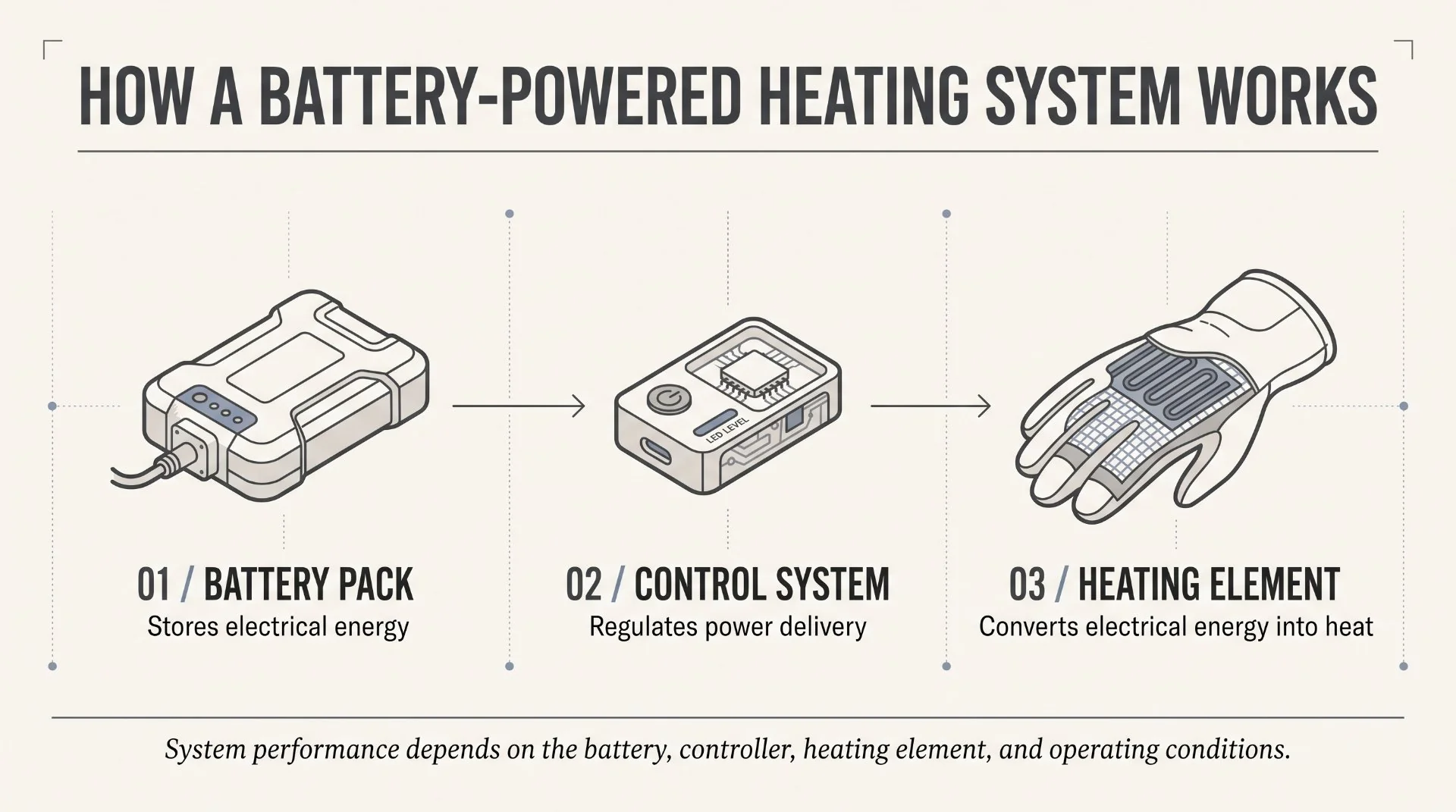
The basic relationship is:
Electrical power (W) = Voltage (V) × Current (A)
For a resistive heating element, power can also be expressed as voltage squared divided by resistance. If resistance remains constant, increasing the voltage across the element increases its electrical power. In a complete heated-wearable system, however, the power actually delivered also depends on the element’s resistance, current limits, controller behavior, and the battery’s capabilities.
For heated gloves, voltage is therefore one input to the power budget—not a complete measure of heating performance. The battery and supporting components must be designed to deliver the intended output within their operating limits.
2. Why Higher Voltage Can Increase Heating Output
For a given resistive heating element, increasing the voltage across it can increase electrical power. That additional power may support greater heating output, provided the element, wiring, connectors, battery pack, and control electronics can accommodate the resulting load.
The relationship is not universal across complete products. A controller may regulate or limit power, and an element designed for one voltage class may not be suitable for another. Increasing the supply voltage without matching the rest of the system can create excessive power or component stress rather than a controlled improvement in performance.
Voltage classes such as 5V, 7.4V, and 12V represent different possible design approaches, not a universal ranking from inferior to superior. Each must be evaluated against the required output, usable battery energy, intended operating duration, component limits, and garment construction.
A higher voltage can be appropriate when the output requirement justifies it. It does not remove the need to design the rest of the system around that requirement.
3. Heating Output and Runtime Are a Trade-Off
Runtime describes how long a battery-powered system operates under specified conditions before its available energy is depleted or the system reaches its cutoff condition. It depends on usable battery energy and the average power consumed by the complete system.
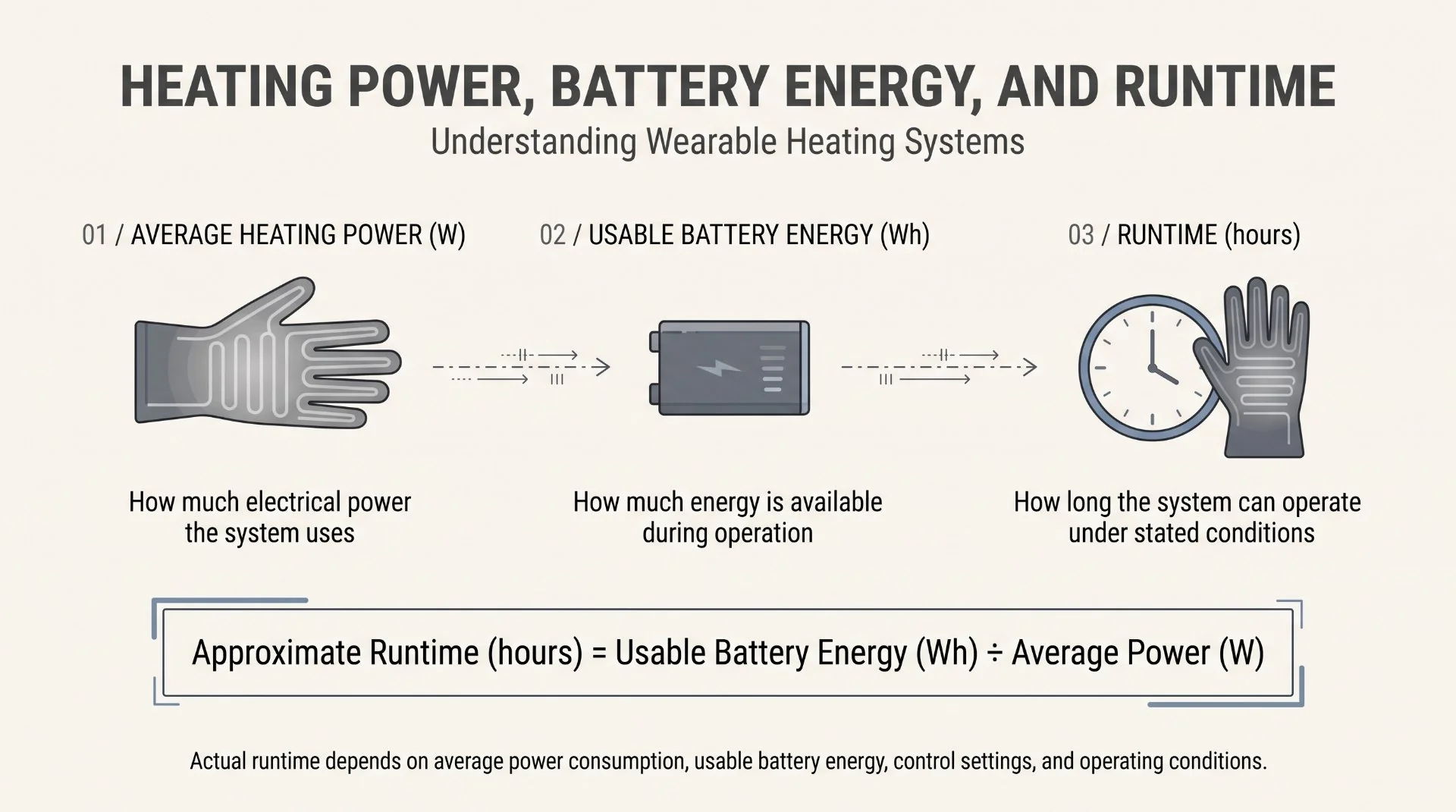
A useful first-order estimate is:
Estimated runtime (hours) ≈ Usable energy (Wh) ÷ Average power consumption (W)
Nominal battery energy can be estimated from nominal voltage and amp-hour capacity:
Nominal energy (Wh) ≈ Nominal voltage (V) × Capacity (Ah)
These equations provide estimates, not guaranteed operating times. Actual runtime depends on usable energy, electrical losses, battery behavior under load, controller operation, and cutoff settings.
Consider two operating modes using the same battery pack. If one mode consumes more average power, it will generally use the available energy sooner. It may provide greater heating output while running, but it should not be assumed to provide the same runtime as the lower-output mode.
Increasing voltage does not necessarily reduce runtime by itself. The result depends on how the voltage change affects system power consumption and whether the battery’s usable energy changes. Runtime claims must therefore be evaluated alongside the output level and test conditions.
4. Why mAh Alone Cannot Establish Runtime
Battery capacity is often advertised in milliamp-hours (mAh). This describes charge capacity, but it does not independently establish stored energy across batteries with different nominal voltages.
Watt-hours (Wh) provide a more useful basis for comparing nominal energy when voltage differs. Even then, the Wh rating does not establish how long a heated garment will operate unless its average power demand and usable energy are also considered.
A meaningful specification should distinguish three things:
- Battery capacity: stated charge capacity and, where available, nominal energy in Wh.
- Heating output: the operating level or power consumption associated with the comparison.
- Measured runtime: the observed duration under clearly stated test conditions.
The U.S. Department of Energy’s overview of batteries explains how batteries store chemical energy and release electrical energy through an external circuit. For a heated wearable, translating that stored energy into operating time also requires knowing the system’s power demand.
Comparing mAh figures alone can obscure differences in voltage and energy. Comparing runtime figures without output conditions can obscure differences in how much power each system delivers.
5. Comparing Low-, Medium-, and High-Voltage Design Approaches
Different voltage classes can support different combinations of output, electrical architecture, and runtime. The appropriate choice depends on the garment’s requirements and the capabilities of the complete power system.
| Design approach | Potential advantages | Trade-offs to evaluate |
|---|---|---|
| Low voltage | May support USB-based charging and a relatively simple power architecture. | Available output must meet the heating requirement; the element and circuit still need to be matched to the supply. |
| Medium voltage | May offer a practical balance between available output, battery configuration, and integration requirements. | Runtime, charging requirements, and component compatibility depend on the actual system design. |
| High voltage | Can support greater output from a given resistive element when the circuit is designed accordingly. | Greater output can increase energy demand; pack mass and charging time depend on battery energy, power capability, configuration, and charging architecture. |
These are broad design tendencies, not fixed performance guarantees. A higher-voltage system does not automatically require a heavier battery pack or charge faster. Pack mass depends on the required energy and power, cell configuration, enclosure, and other design constraints. Charging time depends on the energy to be replenished, the charging system’s power, and the battery’s charging limits.
Voltage should therefore be selected as part of a system-level decision, not used as a standalone performance ranking.
6. Charging Architecture Is Part of the System
The battery does not operate in isolation. Charging time, charger compatibility, connector design, electrical protection, and the pack’s ability to sustain the required output are all part of the power system.
A battery may have sufficient nominal energy on paper but still be unsuitable if it cannot consistently support the required power, if its protection system interrupts operation under the intended load, or if its charging arrangement does not match the product’s requirements.
Charging time also cannot be inferred from battery voltage alone. It depends on the energy that must be replenished, the charging power available, battery characteristics, and the charging system’s limits.
These choices should be resolved alongside the power budget. The battery, charger, connectors, wiring, and controller need to work as a compatible system rather than being selected independently after the heating element is finalized.
Power delivery is only part of the design problem. A system must also be able to maintain its intended output over time, which makes the distinction between peak output and sustained output important. This relationship is examined in Stable Heat vs Peak Heat: Why Sustained Output Matters More.
7. The Battery Pack Has Its Own Thermal and Physical Footprint
A battery pack is both an electrical energy source and a physical component positioned within or near a wearable. Its dimensions, mass, placement, enclosure, and electrical characteristics influence the overall garment design.
The pack also generates heat during operation. That heat belongs in the garment’s thermal budget alongside heat produced by the heating elements and heat transferred through surrounding materials. Its location can affect where heating elements, wiring, insulation, and other components can be placed.
For example, a pack placed in a limited area may constrain the available space for heating elements or wiring. The designer must consider not only whether the pack can deliver the required power, but also whether its location and thermal behavior are compatible with the garment’s construction.
Increasing available output may require a battery and circuit architecture capable of supplying that demand for the intended duration. Depending on the design, this can affect pack size, mass, wiring, connectors, and component selection. A higher voltage does not automatically require a heavier pack; the result depends on energy requirements, power demand, cell configuration, and system design.
Battery placement is therefore not simply a final packaging decision. The pack, heating elements, control electronics, insulation, and garment structure need to be considered together during system design.
8. Why the Power Budget Must Come Before Material Selection
Heating-element placement and garment materials cannot be finalized sensibly without first understanding the system’s electrical requirements. The design needs to establish the intended heating zones, expected output, operating duration, battery arrangement, and control approach.
Those requirements influence the element’s electrical characteristics, the available space for wiring, the battery-pack configuration, and the amount of heat the garment must manage. Material selection then needs to work within those constraints while accounting for flexibility, insulation, construction, and intended use.
For cold-sensitive wearable applications, the initial design constraints must be considered together rather than treating the heating element or garment material as an isolated solution. The broader system-design considerations are covered in Designing Heated Wearables for Cold-Sensitive Hands: Engineering Constraints.
J ONE understands that voltage class sets the output-runtime-power budget of a heated garment, and that runtime claims are meaningless without stating the output they were measured at.
Voltage class helps define the electrical conditions available to the heating element, but it does not independently establish the system’s continuous output. That depends on the matched design of the element, controller, battery, wiring, and other components. If the selected power architecture cannot support the intended operating conditions, changing the battery later may not solve the problem. The element, wiring, controller, charging arrangement, and physical layout may all need to be reconsidered.
This is why the power budget must be established before finalizing material selection. The electrical architecture defines constraints that the heating elements and garment construction must satisfy together.
9. Evaluating a Battery-Powered Heating System
A meaningful engineering evaluation considers the battery and heating system as a connected set of electrical, thermal, and physical constraints. The design review should establish:
- Required output: the intended operating levels and the electrical power associated with each level.
- Energy budget: nominal battery energy, usable-energy assumptions, and expected system consumption.
- Runtime conditions: the output level, control mode, and test conditions used to establish operating duration.
- Power delivery: whether the battery, wiring, connectors, and controller can sustain the required load.
- Charging architecture: charger compatibility, charging time, connections, and protection requirements.
- Physical integration: pack mass, dimensions, placement, and interaction with garment construction.
- Thermal management: heat generated by both the heating elements and the battery pack, together with heat transfer, insulation, and component placement.
These requirements must be assessed together. A system that meets a peak-output target but cannot maintain the intended operating level, provide the required runtime, or fit the garment’s physical constraints has not met the complete design brief.
10. The System-Level Conclusion
Battery voltage matters because it helps define the electrical conditions under which a heating element operates. It does not, on its own, determine heating performance, energy capacity, or operating time.
Higher output can place greater demands on available energy and power delivery. Runtime must therefore be evaluated at a stated output level, while charging requirements, component limits, pack placement, mass, and thermal integration must be considered at the same time.
The engineering objective is not to maximize voltage or peak power in isolation. It is to select a compatible power budget that can deliver the required heating output for the intended duration within the garment’s electrical, thermal, and physical constraints.
For manufacturers, this means treating voltage, energy, output, runtime, and physical integration as connected design decisions from the beginning of development.
Frequently Asked Questions
Does higher battery voltage mean heated gloves produce more heat?
Higher voltage can increase the power delivered to a given resistive heating element, but actual output depends on element resistance, current capability, controller behavior, and the complete electrical design. Voltage alone does not establish system performance.
Why is mAh not enough to compare heated-glove batteries?
mAh describes charge capacity, not energy independently of voltage. Watt-hours provide a more useful nominal-energy comparison across different voltage ratings, while actual runtime also depends on usable energy and power consumption.
What should a heated-glove runtime claim specify?
It should identify the operating output or heat setting and the relevant test conditions. Without that information, runtime figures from different systems cannot be meaningfully compared.