

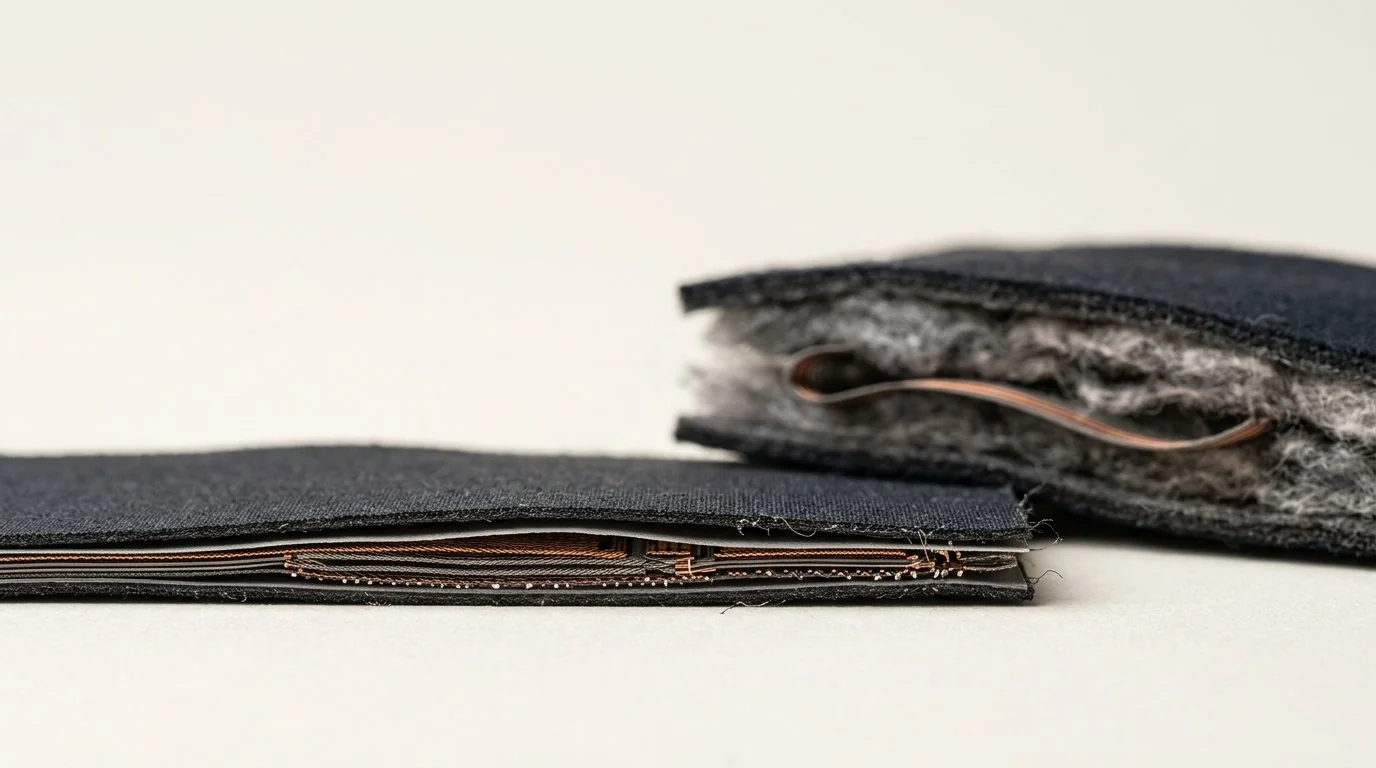
For brands developing ultra thin heated gloves, reducing garment thickness changes more than the product’s profile. It reduces the space available for heating elements, changes how heat moves through the material layers, and makes coverage continuity more difficult to maintain.
In heated wearables, a thinner construction is not simply a thicker design with less material. The heating system must still meet its thermal requirements while operating within a smaller physical envelope.
Thinning the garment does not simply remove material — it shrinks the space available to carry heat, which raises the density the element must deliver and tightens where it can be placed. Thin-layer systems are harder because the same thermal requirement has to be met in a smaller envelope.
1. Why Reducing Thickness Changes the Heating Problem
A heated garment combines several elements: the heating element, textile layers, insulation, wiring or electrical connections, and the surfaces that transfer heat toward the wearer. Each part occupies space and affects how heat moves through the construction.
When thickness is reduced, the available room for these components becomes more limited. Designers may have less space to route electrical connections, position heating elements, manage local transitions, and accommodate material differences without affecting fit or flexibility.
The challenge is therefore not only to make each component smaller. The entire heating system must continue to deliver the intended coverage and output within the revised construction.
2. Coverage Density: The Same Requirement in Less Space
Coverage density describes the relationship between the required heated area and the space available for the heating system. When a garment becomes thinner, the heating system has less room in which to achieve its intended coverage.
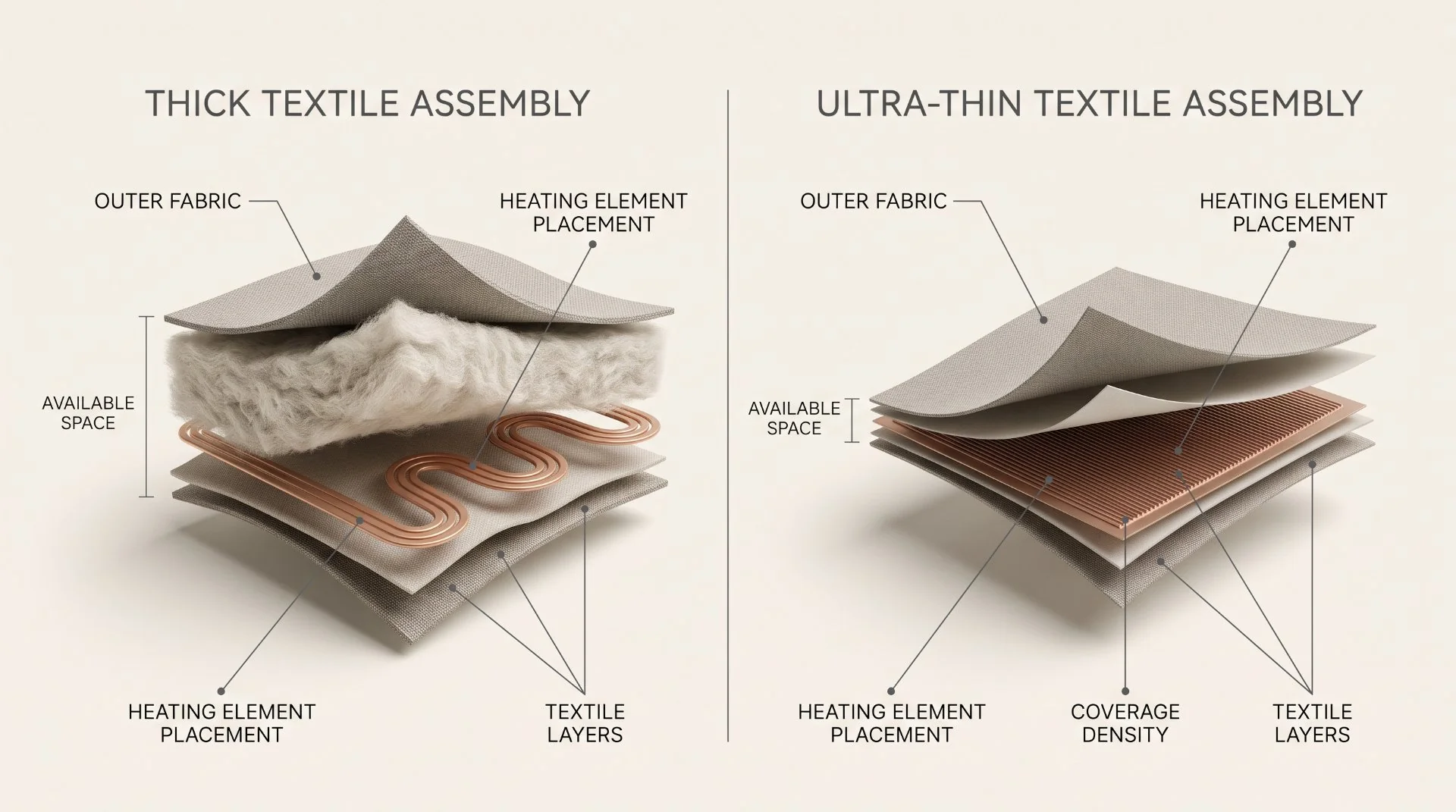
If the required heated area remains unchanged, reducing the available volume can increase the design demands placed on the heating element and its placement. The solution may require a different element geometry, spacing, routing pattern, or distribution of the available electrical power.
This does not mean that every thinner garment automatically needs more total power. Actual power requirements depend on the heated area, target temperature, surrounding conditions, textile properties, heat losses, and how the system is intended to be used.
The engineering point is that reducing thickness changes the constraints. Power density, coverage, and element arrangement must be evaluated together rather than assuming that a smaller heating layer will perform like a larger one.
3. Why a Thinner Heating Element Does Not Guarantee the Same Output
Physical thickness alone does not determine a heating element’s thermal output. Output also depends on the element’s electrical resistance, supplied voltage, current, active area, material properties, and electrical design.
A thinner element may fit into a more compact garment, but that does not establish that it can provide the same heating performance as a thicker element. Its electrical characteristics and the way it transfers heat into the surrounding materials may differ.
Designers must therefore evaluate the complete element and garment system. Relevant checks include the intended power level, distribution of heat across the target area, local temperature variation, electrical connections, and performance under representative operating conditions.
Simply specifying a thinner element without reassessing these factors risks solving the packaging problem while leaving the thermal requirement unresolved.
4. Why Thinness Redistributes the Thermal Budget
The thermal budget is the relationship between heat generated by the system, heat transferred toward the wearer, and heat lost to the surrounding environment. Textile layers influence this balance through their insulation, conductivity, thickness, contact, and construction.
Changing the thickness of one layer can alter the thermal behavior of the entire assembly. A change in insulation may affect heat loss; a change in the outer material may alter how heat moves away from the element; and a change in the inner layer may affect contact with the wearer’s hand.
These effects do not necessarily change in direct proportion to thickness. Different materials have different thermal properties, and the assembled garment behaves as a system rather than as a single uniform layer.
For this reason, the thermal budget should be recalculated when the material stack changes. Designers should not assume that reducing the thickness by a given percentage allows the heating input to be reduced by the same percentage.
5. Why Gaps and Seams Matter More in Thin Construction
Heating coverage depends on more than the total area of the heating element. The positions of elements, gaps between heated areas, seams, folds, and transitions between materials can all affect how evenly heat reaches the intended region.
In a thin construction, these details can become more noticeable because there is less material available to provide additional thermal buffering between the heating element and the wearer. A gap in element coverage or an abrupt transition may therefore have a greater influence on the local thermal experience.
A thicker construction may redistribute heat differently, but thickness alone does not guarantee that local differences will be smoothed. The result depends on the thermal properties and arrangement of the materials, as well as the geometry and spacing of the heating elements.
Design validation should examine the actual heated area and the transitions around it, not just the total heating-element area shown in a design drawing. Seams and construction boundaries must be considered alongside the placement of the heating element.
6. Heating Element Placement: Coverage and Flexibility
In wearable products, heating-element placement affects both thermal coverage and mechanical behavior. The element must occupy a position that supports the intended heated area while accommodating bending, movement, textile construction, and the way the garment fits the body.
Reducing thickness narrows the available placement options. Routing paths, connection points, folds, and seams may compete for the same limited space. An arrangement that works in a thicker garment may not be suitable for a thin layer if it creates uncomfortable transitions or interrupts coverage.
This is why element placement and garment flexibility must be designed together. The engineering considerations are explained further in how heating element placement shapes flexibility and coverage.
7. A Heated Liner and a Standalone Heated Garment Are Different Systems
A heated liner and a standalone heated garment may use similar heating technologies, but they do not operate under identical constraints.
A liner is worn beneath another garment. Its thermal behavior depends partly on the layers around it, including the outer garment’s insulation, fit, and ability to retain heat. The liner’s available space, movement, and contact with the hand may also differ from those of a standalone glove.
A standalone heated garment must be evaluated as its own assembly. Its materials and construction must provide the intended combination of heating coverage, heat retention, fit, and flexibility without relying on another garment to complete the thermal system.
Consequently, a liner should not be treated as merely a thinner version of a standalone heated garment. Its thermal requirements and placement constraints should be defined for the intended layered-use conditions.
8. The Design Constraints Must Be Evaluated Together
Thin-layer heating design involves several connected variables:
- Heating coverage: The area that must receive heat and the continuity of that coverage.
- Element geometry: The dimensions, spacing, and routing of the heating element within the available space.
- Electrical output: The relationship between the element’s electrical characteristics and its required thermal performance.
- Material stack: The thermal properties and arrangement of the layers surrounding the element.
- Construction details: Seams, folds, connections, and transitions that can affect placement or heat distribution.
- Use configuration: Whether the heated layer operates independently or beneath another garment.
Optimizing one variable in isolation may create a problem elsewhere. For example, reducing the element’s size may simplify packaging but change the distribution of heat. Changing the textile stack may improve flexibility while altering heat loss. Moving an element to avoid a seam may change coverage in the intended heated area.
The design process must therefore evaluate the heating element, electrical system, textiles, and garment construction as one integrated system.
9. Define the Thermal Requirements Before Development
Before developing a thin-layer heated wearable, the project team should define the required heated area, intended operating conditions, garment structure, material stack, flexibility requirements, and expected electrical performance.
These requirements establish the constraints against which the design can be assessed. They also help the manufacturer determine whether the proposed thickness, heating-element arrangement, and textile construction can work together.
For a broader view of how these requirements are translated into a product development brief, see the OEM process for turning thermal requirements into a heated wearable.
A defined requirement is more useful than a thickness target alone. The objective is not simply to make the heating layer as thin as possible, but to meet the intended thermal and functional requirements within the available construction space.
10. The J ONE Engineering Perspective
For heated-wearable manufacturers, thin-layer construction requires coordinated decisions about heating-element placement, electrical output, textile properties, and garment assembly. A thickness change can affect all four, so it should be treated as a system-level design change rather than a material reduction exercise.
J ONE understands that reducing thickness is a coverage-density problem, and that thin layers change where heat can be placed — not just how much material is used.
This perspective is particularly important when a product must combine a compact profile with defined heating coverage and wearable flexibility. The design must be assessed against the intended use and construction, with performance validated on the assembled product rather than inferred from component dimensions alone.
Frequently Asked Questions
Why are thin-layer heated gloves harder to engineer?
Thin-layer heated gloves provide less space for heating elements, electrical connections, and thermal-management materials. The design must maintain the intended heating coverage and output within a smaller construction envelope, making element placement, material selection, and coverage continuity more demanding.
Does a thinner heating element produce less heat?
Not necessarily. Thermal output depends on electrical characteristics, supplied power, element geometry, and heat transfer through the surrounding materials. A thinner element may have different performance characteristics, so the complete heating system must be evaluated rather than assuming that thickness alone determines output.
Is a heated liner the same as a thin standalone heated glove?
No. A heated liner operates beneath another garment, so its thermal behavior depends partly on the surrounding layers and fit. A standalone heated glove must meet its requirements as an independent assembly. The two configurations therefore need different assessments of thermal conditions, coverage, and construction constraints.
Engineering note: Thinness is a system-level constraint, not a standalone performance measure. The relevant design question is whether the heating system can meet its intended coverage and thermal requirements within the available space and garment construction.