

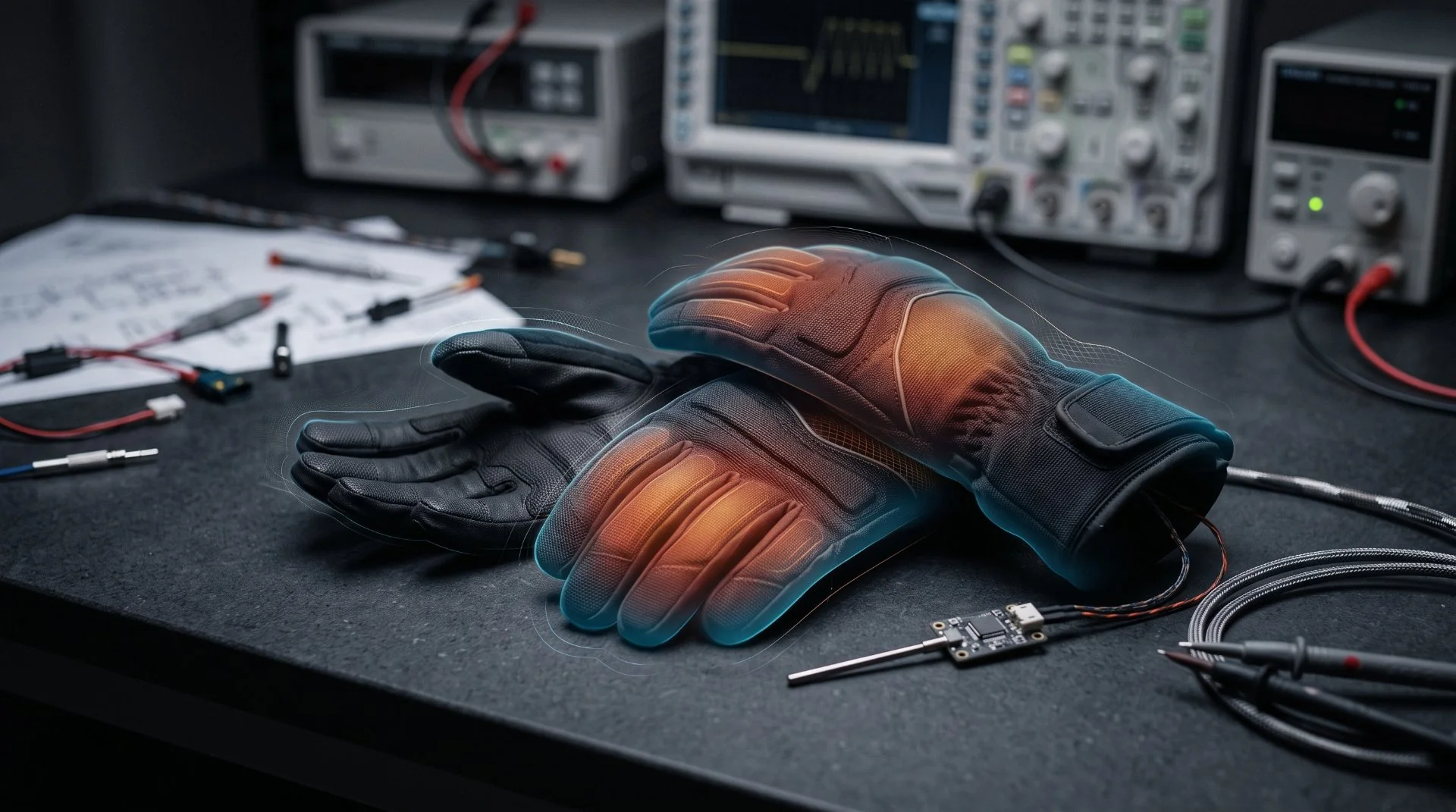
Heated gloves can pose an overheating risk if their heating output is not appropriately controlled for the intended conditions of use. A high heating level, an automatic shutoff function, or a temperature rating alone does not establish that a finished product is safe. Heated gloves overheat safety depends on how the heating elements, temperature limits, control strategy, protective functions, and product-level verification work together.
Temperature control in heated wearables is an engineering problem, not simply a matter of selecting a heating element with a suitable power rating. The design must account for heat generation, heat distribution, environmental conditions, and the way the product is worn.
1. Why Surface Temperature Must Be a Design Constraint
The temperature of a heating element is not the same as the temperature experienced at the wearer’s skin-contact surface. Heat passes through multiple materials, including insulation, liners, fabric layers, and other structural components. Each layer affects how heat is transferred and distributed.
Surface temperature can vary with ambient temperature, airflow, contact pressure, material compression, battery output, and operating duration. A design that performs within its intended range under one condition may behave differently under another.
Heated gloves require particular attention to skin-contact temperature because they may remain in contact with the hands for extended periods. The glove can maintain contact across multiple areas while the wearer moves, grips objects, or compresses the materials. These conditions can change local heat transfer and make temperature distribution difficult to infer from a single measurement. The upper temperature boundary must therefore be considered in relation to both the contact surfaces and the intended duration of wear.
A heating element’s nominal rating cannot substitute for evaluating the finished glove. The design needs defined surface-temperature limits and a verification approach that reflects relevant wearing conditions.
2. Why the Heating Element Alone Cannot Guarantee a Safe Surface Temperature
A heating element converts electrical energy into heat. Its resistance, power input, geometry, and placement influence heat generation, but these characteristics do not independently determine the temperature of the finished product’s surface.
Two products using similar heating elements may produce different surface temperatures because their materials, insulation, construction, and heat-transfer paths differ. Localized hot spots may also occur when heat is distributed unevenly or when part of the heating structure has limited heat dissipation.
Reducing electrical power may reduce heat generation, but it does not by itself prove that all contact areas remain within the intended temperature limits. The complete product must be evaluated.
3. How Temperature Control Works
Temperature control manages heating output according to a defined operating strategy. Depending on the design, this may involve a fixed power setting, timed operation, temperature feedback, or a combination of control functions.
- Control strategy: Determines how the system changes or maintains heating output during operation.
- Temperature sensing: Provides measurements from specific sensor locations when temperature feedback is used.
- Protective cutoff: Interrupts or limits operation when a defined fault or threshold condition is reached, if the product incorporates such a function.
These functions are not interchangeable. A controller that regulates normal output does not necessarily provide independent over-temperature protection. A protective cutoff also does not automatically guarantee uniform temperatures across the entire skin-contact surface.
4. Open-Loop Control, Feedback Control, and Sensor Placement
Open-loop control adjusts heating according to a predefined input without continuously using measured temperature to correct the output. For example, a controller may supply a selected power level for a specified period. The resulting temperature may change when ambient conditions, material properties, contact conditions, or heat dissipation differ from the assumptions used during design.
Feedback control uses sensor measurements to adjust heating output according to a control rule. When implemented appropriately, it can respond to changes detected at the sensor location and help regulate the measured temperature.
However, a sensor measures conditions at or near its sensing location, not the temperature of the entire glove. If the sensor is separated from a contact surface or positioned away from a localized hot spot, its reading may not reflect the highest temperature elsewhere in the product. Measurement accuracy, response time, sensor placement, and control logic therefore affect the quality of feedback control.
5. How Control Precision Affects Wearing Experience
Control precision influences how consistently a heated wearable delivers warmth during use. Large output fluctuations may produce noticeable changes in perceived warmth, while uneven heat distribution may leave some areas warmer than others.
For heated gloves, evaluation should consider the relationship between the heating elements, fingers, palm, back of the hand, and the materials separating the heating system from the wearer. Intended heating coverage and actual temperature distribution are related but distinct design characteristics.
Heating coverage is only one part of the design problem. The placement of heat sources must be considered alongside material construction, insulation, fit, and the constraints of cold-sensitive hands. These interacting constraints are also relevant to designing heated wearables for cold-sensitive hands.
6. How Temperature Limits Constrain Heating Output
A temperature limit defines a design boundary that the product is intended to respect under specified conditions. The control system and protective functions should be designed with that boundary in mind.
A system may regulate output using measured temperature, restrict power according to a predefined operating profile, or combine normal regulation with a separate protective mechanism. These approaches require different forms of verification.
A fixed output limit does not demonstrate actual surface-temperature performance in every condition. A sensor-based limit depends on whether the measurement and control arrangement adequately represents the relevant thermal behavior. The design target, control response, and verification criteria should therefore be defined separately and evaluated together.
Restricting the upper surface temperature creates an engineering trade-off. As the permitted temperature range narrows, the system has less room to increase heat output when conditions become colder or heat loss rises. The design must balance the intended warmth against the upper limit rather than assume that maximum available output can always be used.
7. Why the Highest Heating Level Does Not Mean Stable Heating
The highest heating level describes an available operating setting. It does not establish that the product will maintain a stable surface temperature or distribute heat evenly.
Actual thermal behavior depends on electrical input, heat transfer, material construction, environmental conditions, and control response. A higher power setting may increase heat generation, but it may also increase temperature variation or make thermal management more demanding.
Peak heating output and stable thermal performance are separate characteristics. Evaluating a product’s ability to deliver consistent warmth requires considering how temperature changes over time and across relevant contact areas, rather than relying on maximum output alone. This distinction is central to understanding stable heat versus peak heat output.
A controller may need to reduce output before the system reaches its highest possible heating level. That reduction is not necessarily a performance defect; it may be the consequence of maintaining the required temperature boundary. The relevant question is whether the product can deliver appropriate, consistent warmth while remaining within its defined operating limits.
A held temperature and a protected upper limit are both control outcomes. The safety envelope narrows the usable heat band — which is precisely why stability has to be engineered at the controller, not assumed from the element.
8. Why Automatic Shutoff Is Not Proof of Safety
Automatic shutoff can limit operating time or stop heating when a predefined condition occurs. Its protective value depends on what triggers the function, how reliably it operates, and whether the trigger condition is appropriate for the hazard being addressed.
A timer-based shutoff limits operation duration but does not directly measure surface temperature. A temperature-triggered cutoff depends on the sensor, threshold, response time, and circuit behavior used by the design.
Neither function alone proves that a heated glove cannot overheat. Verification should establish that the relevant protection behaves as intended under defined normal and fault conditions.
9. Temperature Stability Depends on the Complete System
Stable thermal performance is a system-level result. It depends on the interaction between the power source, electrical circuit, heating elements, controller, sensors where used, protective functions, and product materials.
Changes in one part of the system can affect the behavior of the whole product. Battery voltage variation may influence available power; material changes may affect heat transfer; and differences in assembly may influence the position of heating elements or sensors.
The thermal performance of a component cannot therefore be treated as proof of the finished wearable’s performance. Verification should reflect the actual product configuration and the conditions in which it is intended to operate.
10. What Should Be Verified Before Product Acceptance?
Before a heated wearable is accepted for production or release, its thermal behavior and protective functions should be assessed against documented requirements.
- Surface-temperature limits: Define the applicable limits and the locations and conditions under which they must be assessed.
- Temperature distribution: Evaluate relevant contact areas and identify potential hot spots.
- Operating modes: Assess each heating level and relevant combinations of power and operating duration.
- Environmental conditions: Consider the ambient temperatures and other conditions relevant to intended use.
- Extended contact: Evaluate thermal behavior over a duration representative of intended wear, including relevant changes in fit, pressure, and heat dissipation.
- Control response: Verify that the control strategy behaves as specified when operating conditions change.
- Protective functions: Test any automatic shutoff or over-temperature protection included in the product.
- Fault conditions: Evaluate relevant foreseeable faults using an appropriate test plan.
- Production consistency: Establish that the tested configuration corresponds to the product being manufactured.
The appropriate test methods and acceptance criteria depend on the product design, intended use, and applicable requirements. A test result should be interpreted within the conditions and scope of the test; it should not be generalized beyond the evidence it provides.
IEC 63203-406-1:2021 specifies a method for measuring the surface temperature of wrist-worn wearable electronic devices in contact with human skin. It should not be presented as a dedicated heated-glove safety standard. Its relevance to a particular product or test must be assessed against the standard’s actual scope.
11. The Engineering Cost of a Narrower Heating Range
A narrower usable heating range limits how far the system can increase output before reaching its defined upper boundary. In colder conditions, or when heat loss increases, the controller may have less available output to compensate. The product may therefore deliver less peak warmth than a design that permits a higher surface temperature.
This is a real engineering trade-off, not something that can be removed by selecting a more powerful heating element. More available power does not automatically create more usable heat when the upper temperature boundary remains fixed.
The design decision is therefore not simply how much heat the system can generate. It is how much heat can be delivered within the required surface-temperature limits, for the intended duration and conditions of wear. Any claimed balance between warmth and temperature stability should be supported by verification rather than inferred from rated power alone.
12. J ONE’s Engineering Perspective
J ONE understands that thermal stability is engineered through control design and hard surface-temperature limits, not merely selected by choosing a heating element.
Temperature control must be considered alongside heating-element layout, power delivery, materials, skin-contact conditions, and the protective functions incorporated into a specific product. These factors influence the usable heating range and the evidence needed to verify performance.
The specific control methods and protective functions may vary by product. Whether a particular model includes temperature feedback, an independent over-temperature cutoff, or another protective arrangement should be established from that model’s actual design and verification documentation.
Conclusion
Heated gloves overheat safety cannot be established by heating-element specifications, a high or low power setting, feedback control, or automatic shutoff alone. These are individual design characteristics, not substitutes for evaluating the finished product.
A sound engineering approach distinguishes temperature limits, control strategies, protective functions, and verification. It considers temperature distribution, extended skin contact, relevant operating conditions, and the trade-offs created by restricting the usable heating range.
In heated wearables, temperature stability is a system-level engineering property that must be supported by design decisions and appropriate verification evidence.
Frequently Asked Questions
Why is temperature control important in heated gloves?
Temperature control helps manage heating output and thermal behavior during use. Its effectiveness depends on the control strategy, product construction, sensor arrangement where applicable, protective functions, and verification of the finished glove.
Can a heating element maintain a stable surface temperature on its own?
Not necessarily. Surface temperature depends on electrical input, heat transfer, materials, environmental conditions, and product construction. Stable performance must be evaluated at the finished-product level rather than inferred from the heating element alone.
Does automatic shutoff prove that heated gloves cannot overheat?
No. Automatic shutoff can limit operating time or respond to a defined condition, but its protective value depends on its trigger, response, and implementation. Appropriate verification is still required to assess overheating risks under relevant conditions.